Text DAT Files vs Binary DAT Files: What Is the Difference?
DAT files usually fall into two broad groups when you inspect their contents: text DAT files and binary DAT files. The difference matters because each type needs a different way of viewing and understanding the data.
A text DAT file may contain words, numbers, settings, logs, or rows of structured data that you can read directly. A binary DAT file stores bytes in a form designed mainly for software. When opened in a normal text editor, binary data often appears as strange characters or unreadable symbols.
.dat extension because DAT is a generic data-file extension rather than one universal file format.
Text DAT Files and Binary DAT Files at a Glance
Text DAT File
Designed so some or all of the data can be represented as text characters.
- Often readable in a text editor
- May contain settings or logs
- Can contain CSV-style records
- May use commas, tabs, pipes, or semicolons
- Usually searchable as normal text
Binary DAT File
Stores data as bytes that may need software or a defined file structure to interpret correctly.
- Often unreadable in Notepad
- May contain application records
- Can store game resources or media
- Useful to inspect in hexadecimal
- May require the original program
The key point is that the filename alone cannot tell you which type you have. As explained in our guide to whether all DAT files use the same format, different applications can create completely different DAT structures.
What Is a Text DAT File?
A text DAT file stores information using character encodings that text software can interpret. If you open one in a normal editor, much of the content should look like recognizable letters, numbers, punctuation, and spaces.
For example, a program might store preferences like this:
language=en
theme=dark
autosave=true
max_results=50
username=alex
The values are directly readable and could be inspected with a text editor or DAT viewer.
id|customer|total
201|Aisha|35.90
202|Daniel|72.50
203|Mina|18.00
204|Omar|96.40
This file is also text, but its repeating pipe separators make it suitable for a table view.
Text DAT files are not required to follow one particular structure. Some contain simple lines. Others resemble CSV or TSV files. A program can create its own text layout and still save it with a .dat extension.
What Is a Binary DAT File?
A binary DAT file stores information as byte values rather than as a sequence intended to be read directly by a person.
All files are made of bytes at the lowest level. The useful distinction is how those bytes are organized. In a text file, many bytes map directly to characters. In a binary file, a byte or group of bytes may represent an integer, timestamp, image value, index, compressed block, application flag, or something else entirely.
00000000  44 41 54 01 00 10 00 00
00000008  A9 21 F4 00 71 09 8B 33
00000010  52 45 43 00 01 A7 39 F2
00000018  00 00 12 4C B3 19 02 88
A hex view shows each raw byte even when the file is not readable as normal text.
89 AF 02 11 00 80 39 2B
54 45 58 54 55 52 45 00
B3 88 40 FF 10 21 00 09
player_skin_01.....
Binary DAT files can still contain small readable strings mixed with binary bytes.
A general viewer may reveal those readable strings, but interpreting every binary field may require documentation or the application that created the file.
Text vs Binary DAT Files: Main Differences
| Feature | Text DAT file | Binary DAT file |
|---|---|---|
| Readable in a basic text editor | Usually | Usually not |
| Can contain normal words | Yes | Sometimes, mixed with binary data |
| Can use delimiters | Yes | Not in the same plain-text sense |
| Good for spreadsheet import | Sometimes | Usually no |
| Useful in a hex viewer | Possible, but often unnecessary | Yes |
| Easy to search for words | Usually | Only for embedded text strings |
| May require original software | Sometimes | Often |
Similar Posts
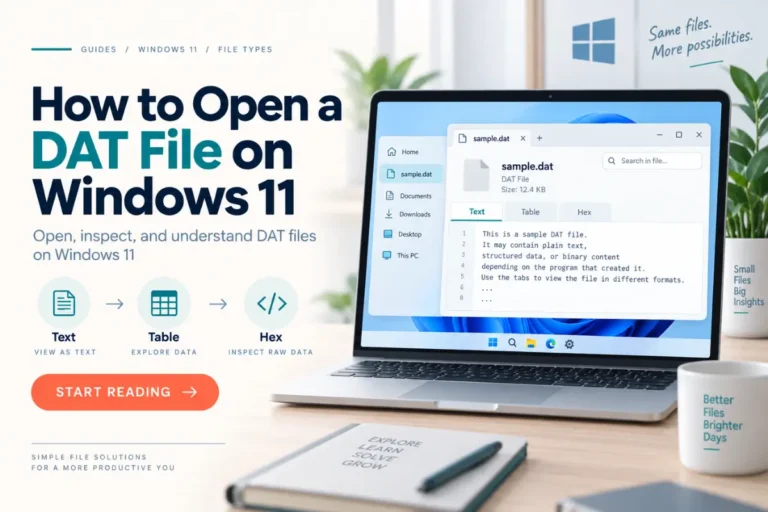
How to Open a DAT File on Windows 11
Windows 11 GuideDAT FilesBeginner Friendly A DAT file can be confusing because the .dat extension does not tell you exactly what is inside the file. One DAT file may contain plain text, while another may store database records, video data, game files, settings, or binary information that only one program can read. Windows 11 does…
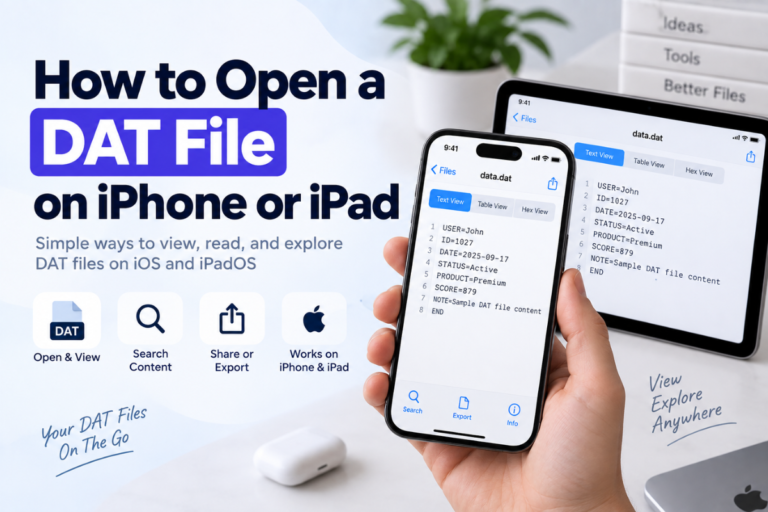
How to Open a DAT File on iPhone or iPad
iPhone and iPad File Guide A DAT file does not belong to one standard format, so your iPhone or iPad may not know which app should open it. The right method depends on whether the file contains text, table data, video, email information, or data created for a specific app. Start in Files Check the…
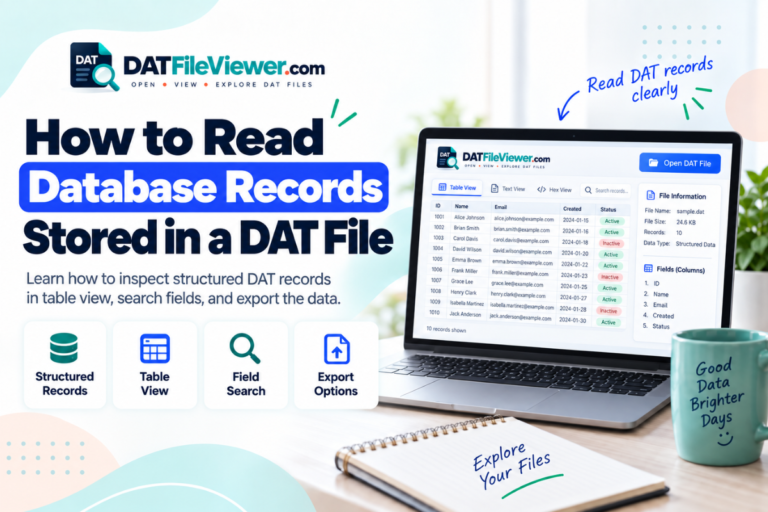
How to Read Database Records Stored in a DAT File
To read database records stored in a DAT file, first identify how the records are structured. Some DAT files store rows as readable text. Others store records in binary form that only the original application can decode correctly. The .dat extension does not define one database format. That means you cannot assume every DAT file…
How to Open a DAT File on Android
Opening a DAT file on Android is not always as simple as tapping the file. The reason is that .dat is a general file extension. It does not describe one specific type of data. One DAT file may contain readable text. Another may store video, app settings, database records, email data, or binary information that…
Can a DAT File Contain Video?
Yes, a DAT file can contain video. In some cases, the file may contain standard video data. In others, it may hold video clips inside a larger application-specific container. One well-known example is Video CD, or VCD. Video CDs commonly store MPEG-1 video in files with names such as AVSEQ01.DAT. However, this does not mean…
Can You Open DAT Files With Google Sheets?
Google Sheets can work with some DAT files, but it does not treat .dat as one standard spreadsheet format. Whether it works depends on what is stored inside the file. If the DAT file contains readable rows separated by commas, tabs, semicolons, or pipe characters, you can often move that data into Google Sheets. If…