How to View Image Data Stored Inside a DAT File
To view image data stored inside a DAT file, first determine how the image is stored. A DAT file may contain a complete JPG or PNG image, several embedded images, raw pixel data, or proprietary graphics that only the original application can decode.
That means there is no single “open image from DAT” method that works for every file. Start by inspecting the DAT file in text and hexadecimal views. Then look for image signatures, filenames, resource labels, or clues from the software that created it.
Do not rename the DAT file to JPG or PNG first. Inspect the bytes and identify whether standard image data is actually present. If the graphics use a private application format, you may need the original software to render them correctly.
First Understand What “Image Data” Can Mean
Image data inside a DAT file can take several forms. These forms need different viewing methods.
Full image
A complete PNG, JPEG, GIF, or BMP may be stored inside the DAT file.
Multiple images
The DAT file may act as a container for many textures, thumbnails, icons, or graphics.
Raw pixels
Pixel values may be stored without a normal JPG or PNG wrapper.
Private format
The application may compress or encode graphics using its own resource structure.
If you are still deciding whether your file is likely to contain graphics at all, read Can a DAT File Contain Images? first.
Step 1: Find Out Where the DAT File Came From
The file’s source can narrow down the possibilities before you inspect a single byte.
A DAT file inside a game’s texture or asset folder is more likely to contain visual resources than a DAT file created by accounting software. A thumbnail cache may contain small previews. A photo-management program may store references, metadata, or actual image data.
Look at:
- The parent folder
- Nearby files
- The DAT filename
- The program that created it
- Any matching resource folders
If you do not know the source, see How to Find Out What Created a DAT File.
Step 2: Search Readable Text for Image Clues
Before working with hexadecimal data, check whether the DAT file contains readable strings.
You may find:
menu_background.png
player_idle_01.png
icon_inventory.bmp
loading_screen.jpg
textures/terrain/grass_02
A DAT file may simply contain a list of paths that point to separate image files. Check nearby folders before assuming the graphics are embedded.
logo.png inside a DAT file is not the same as finding an actual PNG byte sequence inside the file.
Step 3: Switch to Hex View
If the DAT file is mostly binary, hexadecimal view is the most useful next step.
A hex viewer displays each byte using values from 00 to FF. This makes known image signatures easier to spot.
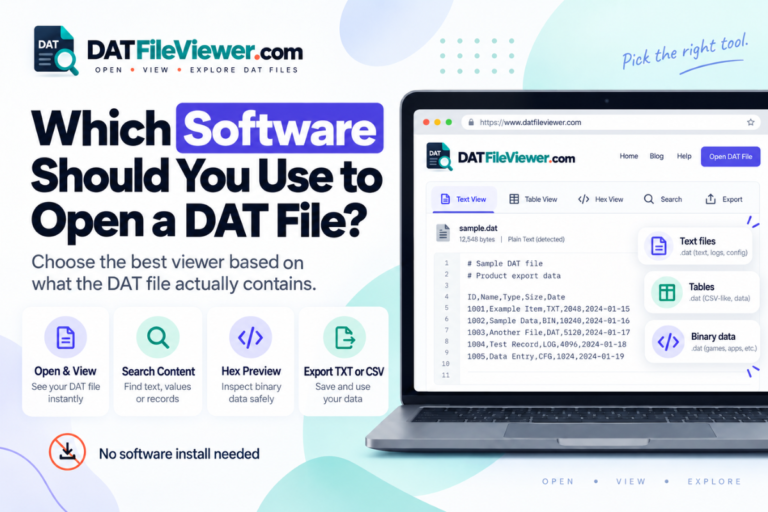
Our DAT File Viewer includes a hex view for binary inspection. It does not claim to decode every proprietary image container, but it can help you find signatures and readable resource names.
Look for Common Image File Signatures
Many common image types start with predictable bytes.
JPEG
JPEG images commonly begin with FF D8 FF.
PNG
PNG starts with 89 50 4E 47 0D 0A 1A 0A.
GIF
GIF files commonly begin with readable text such as GIF87a or GIF89a.
BMP
BMP images normally begin with the ASCII letters BM, which are bytes 42 4D.
If one of these signatures appears at byte zero, the whole DAT file may actually contain one standard image stored under a DAT extension.
If the signature appears later, the file may contain an embedded image inside a larger container.
What an Embedded PNG Can Look Like
000004F0  31 00 10 A8 02 00 00 00  89 50 4E 47 0D 0A 1A 0A
00000500  00 00 00 0D 49 48 44 52  00 00 04 00 00 00 02 00
00000510  08 06 00 00 00 95 38 0B  A1 00 00 00 09 70 48 59
The next challenge is determining where that image ends.
A standard image format has its own internal structure, but a DAT container may place another asset immediately after it. Extracting the correct byte range requires care.
Step 4: Decide Whether the Image Is Embedded or Referenced
Use the evidence you find to classify the file.
| Evidence | Likely meaning | What to do |
|---|---|---|
Readable path such as images/logo.png |
DAT may reference an external file | Check nearby folders |
| PNG or JPEG signature inside binary bytes | Possible embedded image | Inspect the surrounding byte range |
| Many texture names and no common signatures | Possible proprietary resource format | Identify the source application |
| Raw repeated pixel-like values | Possible raw graphics data | You need dimensions and pixel format |
Step 5: Check Whether the DAT Contains One Image or Many
A file containing one complete image is much easier to deal with than a resource archive containing dozens or hundreds of graphics.
You may find multiple signatures at different offsets, for example:
Offset 0x00000820   PNG image
Offset 0x0001A940   PNG image
Offset 0x0002F100   JPEG image
Offset 0x000418B0   PNG image
There may also be an index near the beginning of the file that stores asset names, offsets, lengths, dimensions, or compression flags.
If you do not understand that index, extracting images manually can produce incomplete or corrupted output.
Step 6: Understand Raw Image Data
Not every graphic inside a DAT file is stored as PNG, JPEG, GIF, or BMP.
Some applications store raw pixel values.
To display raw image data correctly, you may need to know:
- Image width
- Image height
- Bits per pixel
- Color channel order
- Whether transparency is present
- Row padding
- Compression method
- Byte order
Without this information, a block of pixel bytes cannot reliably be turned into a picture.
Why Image Width and Height Matter
Suppose you have raw RGB data with three bytes per pixel.
A 100 by 100 pixel image requires:
100 × 100 × 3 = 30,000 bytes
But 30,000 bytes could also be arranged using other dimensions. Without metadata or format documentation, you cannot know the intended shape from the byte count alone.
This is one reason proprietary image DAT files can be difficult to view outside the original software.
What If the Image Data Is Compressed?
Games and media applications often compress resources inside DAT containers.
In that case, you may find an image name but no obvious PNG or JPEG signature because the image bytes have been compressed or transformed before storage.
The DAT file may contain information such as:
name=player_texture
offset=0x18A400
compressed_size=18420
original_size=65536
format=texture_rgba
compression=custom
A normal image viewer cannot display this data directly. The data needs to be decompressed and interpreted using the correct resource format.
Can You View DAT Image Data With a Normal Image Viewer?
Only in limited cases.
A standard image viewer expects a recognized image format. It usually cannot read a DAT resource container, locate an embedded picture, or understand a private texture format.
Normal image viewer may work
The DAT file is actually one complete standard PNG, JPEG, GIF, or BMP saved with the wrong or custom extension.
Normal image viewer will not be enough
The DAT contains multiple resources, raw pixels, custom compression, indexes, or application-specific graphics.
Should You Rename DAT to JPG or PNG?
Not as your first step.
Changing:
picture.dat
to:
picture.jpg
does not convert anything.
The rename only changes the filename. If the file already contains one complete JPEG, the new extension may help some software recognize it. If the file contains a resource container or raw graphics data, the rename does nothing useful.
This is the same reason renaming other DAT files does not convert their underlying format.
Can You Extract the Image Data?
Sometimes.
If a standard image is stored as one complete embedded block, extraction can be possible once you identify the correct start and end offsets.
It becomes more difficult when:
- The image is split into chunks
- The data is compressed
- The container stores palettes separately
- The image uses a private texture format
- The asset is encrypted or obfuscated
- The DAT index is needed to locate resource boundaries
In these situations, format-specific software is safer and more accurate than manually cutting bytes from the file.
Use the Original Application When Possible
If you know which program created the DAT file, check whether that application can display or export its image resources.
This is often the best route because the original program knows the resource structure.
For example, it may understand:
- Where each image starts
- Image dimensions
- Internal compression
- Texture formats
- Color palettes
- Resource indexes
A general DAT viewer cannot infer every private format automatically.
What Can a DAT Viewer Help With?
A general viewer is most useful during the inspection stage.
You can use text and hex views to:
- Search for image filenames
- Find words such as
texture,thumbnail, oricon - Inspect image signatures
- See whether the file is mostly text or binary
- Look for repeated resource patterns
- Identify application names or paths
If your DAT file is mostly binary, the guide How to Tell Whether a DAT File Is Text or Binary explains how to confirm that first.
What If the DAT File Is Very Large?
Large image-resource containers can be hundreds of megabytes or more.
A basic text editor is not a good choice for this kind of file. Large-file protection and limited binary previews are more practical for initial inspection.
Your DAT viewer uses large-file protection and preview limits, so you can inspect the file before deciding whether you need specialist extraction software.
Which Viewing Method Should You Choose?
Can a Browser Show the Actual Embedded Image?
A browser can display normal image formats, but it still needs a valid image byte stream.
A browser-based DAT viewer can help locate evidence inside the DAT file, but it cannot automatically turn every unknown binary region into a picture.
If you want to understand the role of the browser in DAT inspection, read Can a Web Browser Open DAT Files?.
Do Not Confuse Viewing With Converting
Viewing means understanding what the DAT file contains.
Conversion means producing a new file in another format.
If a DAT file contains one valid PNG image, recovering that PNG may be straightforward. If it contains twenty proprietary textures, there is no meaningful way to convert the entire DAT file into one PNG.
Need to Inspect Image Data Inside a DAT File?
Search readable strings, inspect binary bytes, look for image signatures, and identify whether the file contains standard images or a proprietary resource format.
Inspect Your DAT FileFrequently Asked Questions
How do I view an image stored inside a DAT file?
Start by inspecting the DAT file for image signatures or readable image names. If it contains a complete standard image, extraction may be possible. Proprietary image data may require the original application.
How can I find a PNG inside a DAT file?
Use a hex view and look for the PNG signature 89 50 4E 47 0D 0A 1A 0A. A match can indicate where an embedded PNG begins.
How can I find a JPEG inside a DAT file?
JPEG files commonly begin with FF D8 FF. Finding that sequence can be a clue, but you still need to determine the correct image boundaries.
Can I view raw image data without knowing the dimensions?
Usually not reliably. Raw pixels often require width, height, color depth, channel order, and other format details before they can be displayed correctly.
Can a DAT file contain several images?
Yes. A DAT resource container can hold many images, textures, thumbnails, and other assets inside one file.
Can I rename a DAT file to PNG to view it?
Renaming does not convert the data. It may only help if the DAT file already contains one complete PNG file and the extension is the only thing that is unusual.
Why can I find image names but no image signatures?
The DAT file may contain only references to external images, or the graphics may be compressed or stored in a proprietary format without standard PNG or JPEG signatures.
Start With Signatures, Context, and the Original Format
Viewing image data inside a DAT file starts with identifying how the graphics are stored.
Search for filenames and resource labels. Inspect binary data for known image signatures. Check whether the file contains one image or many. If standard image signatures are absent, consider raw pixels, compression, or a proprietary resource format.
Do not assume a DAT file can be opened directly in an image viewer, and do not rely on changing the extension.
If you already have the file, you can open your DAT file online and inspect its text and hex views before deciding whether you need an image extractor or the original application.